
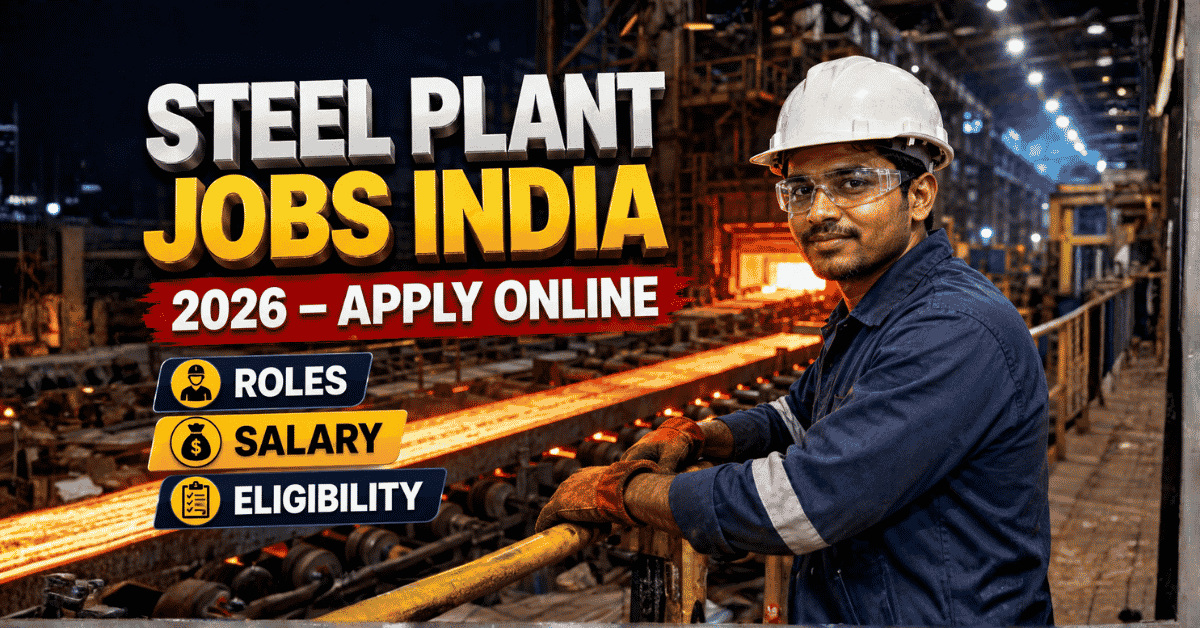
India’s steel industry stands at the most ambitious crossroads in its history. As the world’s second-largest steel producer and a country targeting 300 million tonnes per annum (MTPA) of steel production capacity by 2030 — up from approximately 160 MTPA today — India’s steel plants are expanding, modernising, and hiring at a scale that has not been seen in decades. Steel Plant Jobs India 2026 represent some of the most financially rewarding, technically challenging, and genuinely career-defining employment opportunities available to engineers, ITI-qualified technicians, and entry-level industrial workers anywhere in the country’s manufacturing sector.
Working in a steel plant is unlike working in any other industry. The scale is extraordinary — a single integrated steel plant can occupy 20 to 30 square kilometres, employ 15,000 to 40,000 people, consume electricity equivalent to a small city, and produce 3 to 8 million tonnes of steel every year. The processes involved — from raw material handling through blast furnace ironmaking, basic oxygen steelmaking or electric arc steelmaking, continuous casting, hot rolling, cold rolling, and finishing — represent some of the most powerful and technically sophisticated industrial operations on earth. Workers who build their careers in steel plants develop skills, exposure, and professional credibility that no other manufacturing sector can match.
2. India’s Steel Industry in 2026 – Why It Is the Best Time to Join
300 MTPA Target Driving Historic Investment: The Government of India’s National Steel Policy targets 300 MTPA of steel production capacity by 2030. Achieving this requires adding nearly 140 MTPA of new capacity in less than a decade — meaning new blast furnaces, new electric arc furnaces, new rolling mills, and entirely new integrated steel plants are being constructed simultaneously across the country. Every new capacity addition requires a trained permanent workforce, creating a hiring demand that will sustain throughout the decade.
Infrastructure Boom Creating Insatiable Steel Demand: India’s unprecedented infrastructure programme — ₹10 lakh crore of annual capital expenditure covering highways, railways, metro systems, airports, ports, power plants, and defence infrastructure — is consuming structural steel, TMT bars, plates, pipes, and coils at record volumes. Steel plants that cannot increase production fast enough are adding shifts, upgrading equipment, and expanding headcount to capture this infrastructure-driven demand.
Automobile and Manufacturing Sector Growth: India’s ambition to become a global manufacturing hub — driven by PLI schemes across automobiles, electronics, defence, and capital goods — requires high-quality flat steel products. Automotive steel, electrical steel for EV motors, high-strength steel for defence applications, and specialty alloy steel for advanced manufacturing are all segments where Indian steel plants are urgently adding capacity and workforce.
PSU Steel Expansion and Government Support: SAIL, RINL, and NMDC Steel are all implementing capacity expansion projects that are directly creating government job opportunities with PSU security, pension, and comprehensive benefits — exactly the kind of employment that millions of Indians prioritise. SAIL’s expansion at Bokaro, Bhilai, Rourkela, and Durgapur, and RINL’s expansion at Vizag, are among the largest government manufacturing investments underway in India today.
Private Steel Giants Racing Each Other: JSW Steel, Tata Steel, and JSPL are competing aggressively to increase production capacity — each targeting 40–50 MTPA individually by 2030. This competitive race means all three are simultaneously building new facilities, hiring fresh workforces, and offering increasingly attractive compensation packages to attract and retain the best talent.
Green Steel and Technology Transition: India’s steel industry is beginning its transition toward green steel — reducing carbon emissions through hydrogen-based direct reduction, electric arc furnace steelmaking using renewable electricity, and carbon capture technology. This technology transition is creating entirely new job categories for which the current workforce does not yet exist — opportunity for candidates who are willing to learn new skills in a rapidly evolving sector.
3. Major Steel Companies Actively Hiring in 2026
Steel Authority of India Limited (SAIL) – Largest Government Steel Company Headquarters: New Delhi | Plants: Bhilai (CG), Bokaro (Jharkhand), Rourkela (Odisha), Durgapur (WB), Burnpur (WB), Salem (Tamil Nadu), Bhadravati (Karnataka), Visvesvaraya (Karnataka) Workforce: 65,000+ | Open Positions: 1,000+ Salary Range: ₹20,000–₹1,20,000/month (across all levels) Key Advantage: India’s largest steel PSU, government job security, lifetime pension, best township infrastructure, all-India plant presence Recruitment: sail.co.in/careers | Formal examination-based process
Tata Steel Limited Headquarters: Mumbai | Plants: Jamshedpur (Jharkhand), Kalinganagar (Odisha), Angul (Odisha), Khopoli (Maharashtra) Workforce: 35,000+ in India | Open Positions: 500+ Salary Range: ₹22,000–₹1,50,000/month Key Advantage: India’s most respected private steel company, world-class Jamshedpur township, best training infrastructure in private sector, Tata brand value Website: careers.tatasteel.com
JSW Steel Limited (India’s Largest Private Steel Company) Headquarters: Mumbai | Plants: Vijayanagar (Karnataka), Dolvi (Maharashtra), Vasind (Maharashtra), Tarapur (Maharashtra), Salem (Tamil Nadu), Bhushan Steel Angul (Odisha) Workforce: 40,000+ | Open Positions: 600+ Salary Range: ₹20,000–₹1,40,000/month Key Advantage: India’s largest private steel producer, fastest capacity growth, aggressive hiring targets, JSW Group strength Website: jsw.in/careers/jsw-steel
Jindal Steel and Power Limited (JSPL) Headquarters: New Delhi | Plants: Raigarh (CG), Angul (Odisha), Patratu (Jharkhand), Barbil (Odisha) Workforce: 25,000+ | Open Positions: 350+ Salary Range: ₹18,000–₹1,20,000/month Key Advantage: O.P. Jindal Group, rapidly growing company, accessible entry requirements, strong Chhattisgarh and Odisha presence Website: jindalsteelpower.com/careers
ArcelorMittal Nippon Steel India (AM/NS India) Headquarters: Mumbai | Plants: Hazira (Gujarat), Pellet plant Paradip (Odisha) Workforce: 15,000+ | Open Positions: 250+ Salary Range: ₹22,000–₹1,50,000/month Key Advantage: World’s largest steel company collaboration, world-class European steel technology, highest private sector salary in the flat steel segment Website: amnsindia.com/careers
Rashtriya Ispat Nigam Limited (RINL / Vizag Steel) Headquarters: Visakhapatnam | Plant: Visakhapatnam (Andhra Pradesh) Workforce: 17,000+ | Open Positions: 300+ Salary Range: ₹20,000–₹1,10,000/month Key Advantage: South India’s only integrated PSU steel plant, government PSU security, excellent township, strong local hiring preference in AP and Telangana Website: rinl.in/careers
NMDC Steel Limited Headquarters: Hyderabad | Plant: Nagarnar (Chhattisgarh) — India’s newest greenfield integrated steel plant Workforce: 5,000+ and growing rapidly | Open Positions: 400+ Salary Range: ₹18,000–₹90,000/month Key Advantage: India’s newest and most technologically modern integrated steel plant, fastest-growing PSU steel employer, brand-new equipment and technology Website: nmdc.co.in/careers
4. Steel Plant Job Roles – Complete Role Guide Across All Levels
Entry Level – Trainee / Apprentice / Helper
Blast Furnace Helper / Trainee Blast furnace helpers and trainees assist the operating team in managing the ironmaking process — handling raw materials (iron ore, sinter, coke, limestone), assisting with tapping floor operations during iron and slag tapping, maintaining cleanliness in the cast house area, supporting the maintenance team during planned and emergency repairs, and learning the blast furnace operation under senior operator guidance. This is the most entry-level production role in an integrated steel plant and requires physical fitness, heat tolerance, and a strong commitment to safety. Eligibility: 8th–10th pass | Age 18–30 Salary: ₹12,000–₹18,000/month Total Monthly Earnings: ₹16,000–₹24,000 with shift allowance
Rolling Mill Helper / General Trainee Rolling mill helpers assist operators in managing hot and cold rolling mill operations — handling coils, bars, and sections at the entry and exit sides of the mill, assisting with crop end removal, performing basic quality checks under supervision, and maintaining mill area cleanliness. Physical strength and alertness around heavy moving material are essential. Eligibility: 10th pass | Age 18–30 Salary: ₹13,000–₹19,000/month
Apprentice (ITI Trade Apprenticeship) Under the Apprentices Act, steel plants are mandated to engage ITI-qualified apprentices across all trades — Fitter, Turner, Electrician, Welder, Instrument Mechanic, and others. Apprenticeships provide stipend-based training for one to two years with the possibility of absorption into permanent employment based on performance and vacancy. Eligibility: ITI certificate in relevant trade | Age 18–28 Stipend: ₹8,000–₹14,000/month Absorption Salary on Confirmation: ₹20,000–₹28,000/month
Skilled Level – Operator and Technician
Blast Furnace Operator Blast furnace operators are responsible for controlling one of the most complex and powerful industrial processes in existence — the continuous production of liquid pig iron from iron ore, coke, and limestone inside a furnace operating at over 1,500°C. Their responsibilities include monitoring and adjusting furnace parameters (blast pressure, temperature, gas composition, burden distribution), coordinating iron tapping and slag tapping operations, responding to process deviations and emergencies, maintaining detailed shift records, and ensuring the safety of the entire cast house team. Eligibility: 10th–12th pass + ITI in relevant trade | Minimum 2 years’ steel plant experience preferred Salary: ₹22,000–₹36,000/month permanent Total Monthly Earnings: ₹30,000–₹48,000 with shift allowance and overtime
Steel Melting Shop (SMS) / Converter Operator SMS operators manage the Basic Oxygen Furnace (BOF) or Electric Arc Furnace (EAF) steelmaking process — converting liquid pig iron or steel scrap into liquid steel of the specified chemical composition. This involves controlling oxygen blowing parameters, monitoring steel bath temperature, adding alloy additions and fluxes, coordinating with the secondary metallurgy team, and ensuring that every heat of steel meets the required chemistry for the downstream casting operation. Eligibility: 10th–12th + ITI | Experience in high-temperature metallurgical operations preferred Salary: ₹24,000–₹38,000/month Total Monthly Earnings: ₹32,000–₹50,000
Continuous Casting Machine (CCM) Operator CCM operators manage the solidification of liquid steel into semi-finished shapes — slabs, blooms, or billets — through the continuous casting machine. They control mould oscillation, cooling water flow, casting speed, and tundish operations, monitor for breakout conditions, adjust mould powder usage, and ensure the quality of the cast product. Any mistake at the CCM can cause a costly and dangerous steel breakout — making this one of the highest-responsibility operator roles in a steel plant. Eligibility: 10th–12th + ITI | Basic metallurgy knowledge is valued Salary: ₹24,000–₹38,000/month Total Monthly Earnings: ₹32,000–₹50,000
Hot Rolling Mill Operator Hot rolling mill operators manage the transformation of cast slabs or blooms into hot rolled coils, plates, or sections at temperatures above 1,000°C. They operate rolling stands, control pass schedules and reduction sequences, monitor product dimensions and surface quality, manage coiler and cooling equipment, and respond to cobbles and mill stoppages. Modern hot strip mills are highly automated with computerised pass schedule control — operators work at HMI consoles monitoring automated sequences while intervening for exceptions. Eligibility: 10th–12th + ITI in Mechanic or Fitter trade | Rolling mill experience strongly preferred Salary: ₹22,000–₹36,000/month Total Monthly Earnings: ₹30,000–₹46,000
Cold Rolling Mill Operator Cold rolling mill operators manage the further reduction of hot rolled coils to thinner gauges at room temperature — the process that produces the flat-rolled steel used in automobiles, appliances, and construction products. Cold rolling requires precise thickness control, tension management, and surface quality monitoring. Associated processes including pickling, annealing, skin-pass rolling, and galvanising are also operated and monitored by this team. Eligibility: 10th–12th + ITI | Experience in cold rolling or sheet metal processing preferred Salary: ₹22,000–₹36,000/month
Electrical Maintenance Technician Electrical maintenance technicians at steel plants maintain the enormous electrical infrastructure that powers every process — from 33kV main distribution to individual drive motors on rolling mills, cranes, and conveyors. They troubleshoot and repair motor control centres, variable speed drives, power factor correction equipment, and electrical safety systems. Steel plant electricians work with some of the largest and most powerful electrical equipment in Indian industry. Eligibility: ITI in Electrician (mandatory) + Wireman Licence | HT electrical experience is highly valued Salary: ₹22,000–₹38,000/month Total Monthly Earnings: ₹30,000–₹50,000 with overtime and emergency call-out allowances
Mechanical Maintenance Technician Mechanical maintenance technicians maintain the vast mechanical infrastructure of a steel plant — rolling mill rolls and chocks, hydraulic and lubrication systems, gearboxes, couplings, conveyors, cranes, and all process machinery. Planned preventive maintenance, emergency breakdown response, and major overhaul execution are all within their scope. Eligibility: ITI in Fitter, Mechanic (Industrial), or Hydraulics and Pneumatics Salary: ₹20,000–₹36,000/month Total Monthly Earnings: ₹28,000–₹48,000
Crane Operator Steel plant crane operators handle some of the heaviest and most critical lifts in Indian industry — moving ladles of liquid steel weighing 300+ tonnes, coils weighing 15–25 tonnes, and heavy rolling mill components. Precise crane operation in a hot, visually challenging steel plant environment requires exceptional concentration, spatial awareness, and safety discipline. Crane operators typically hold an ITI certificate and a Crane Operator licence from the relevant state Factory Inspectorate. Eligibility: ITI in any mechanical trade + valid Crane Operator licence Salary: ₹18,000–₹32,000/month Total Monthly Earnings: ₹24,000–₹42,000
Graduate Level – Junior Officer / Management Trainee
Junior Officer – Operations (Engineering Graduate) Junior officers in the operations stream manage specific process sections — blast furnace, SMS, CCM, hot rolling, cold rolling, or finishing — under the guidance of senior managers. They are responsible for shift production targets, product quality, safety compliance, and team leadership of the operator and technician workforce in their section. JOs are groomed for rapid progression to section manager and department manager roles. Eligibility: B.Tech / B.E. in Metallurgy, Mechanical, Electrical, or Chemical Engineering | Minimum 60% marks | Age below 28 Salary: ₹35,000–₹55,000/month (starting) at SAIL, RINL | ₹45,000–₹70,000/month at Tata Steel, JSW, AM/NS Total Package: ₹5–₹10 lakhs per annum CTC at PSUs | ₹7–₹15 lakhs CTC at private companies
Management Trainee (MT) Management trainees are the leadership pipeline of every major steel company. MTs undergo 12–18 months of structured rotational training across all plant departments before being assigned to a specific functional area. SAIL, RINL, and NMDC recruit MTs through formal written examinations (SAIL MT exam, RINL MT exam). Private companies like Tata Steel and JSW recruit through campus placements and direct application with structured assessment processes. Eligibility: B.Tech/B.E. in relevant discipline + strong academic record | For SAIL/RINL — GATE score is accepted for screening Starting Salary: ₹40,000–₹60,000/month at PSUs | ₹55,000–₹85,000/month at Tata Steel, JSW Annual CTC: ₹8–₹14 lakhs (PSU) | ₹12–₹22 lakhs (private)
Junior Officer – Finance, HR, Marketing, Materials Non-technical functions also recruit graduates and postgraduates for roles in finance, HR and industrial relations, procurement and materials management, marketing and dispatch, and corporate affairs. These roles require MBA, CA, or relevant postgraduate qualifications. Eligibility: MBA (HR, Finance, Operations) or CA/CMA | Age below 30 Salary: ₹35,000–₹65,000/month starting
Senior and Specialist Level
Shift Manager / Section Manager Experienced engineers and technical staff who have demonstrated production expertise and leadership ability are promoted to shift manager and section manager roles — responsible for 24-hour production continuity, team management of 50–200 workers, quality and safety performance of the section, and liaison with other departments. Salary: ₹65,000–₹1,20,000/month
Process Metallurgist / Quality Assurance Specialist Process metallurgists analyse steel chemistry, mechanical properties, and process parameters to improve product quality and reduce defects. They interact with customers on quality complaints, develop new steel grades, and drive continuous improvement in process consistency. Eligibility: B.Tech in Metallurgy + relevant experience | M.Tech in Metallurgy preferred for specialist roles Salary: ₹55,000–₹1,10,000/month
Automation and Instrumentation Engineer With steel plants rapidly automating toward Industry 4.0 — deploying Level 2 process automation, AI-based process optimisation, predictive maintenance systems, and digital twin technology — automation engineers who can programme PLCs, configure SCADA systems, and develop process models are among the most valuable and highest-compensated technical staff in any steel plant. Eligibility: B.Tech in Electrical, Electronics, Instrumentation, or Computer Science Salary: ₹55,000–₹1,20,000/month
5. Steel Plant Salary Table – Comprehensive Earnings Guide
| Role Category | Position | Base Salary | Allowances | Total Monthly |
|---|---|---|---|---|
| Entry Level | Blast Furnace Helper | ₹12,000 | ₹4,000 | ₹16,000 |
| Entry Level | General Trainee | ₹15,000 | ₹5,000 | ₹20,000 |
| Skilled | Furnace Operator (Fresher) | ₹22,000 | ₹8,000 | ₹30,000 |
| Skilled | Furnace Operator (5 Yrs) | ₹32,000 | ₹10,000 | ₹42,000 |
| Skilled | Electrician (Experienced) | ₹28,000 | ₹10,000 | ₹38,000 |
| Skilled | Crane Operator | ₹22,000 | ₹8,000 | ₹30,000 |
| Graduate | Jr. Officer / MT (PSU) | ₹40,000 | ₹15,000 | ₹55,000 |
| Graduate | Jr. Officer (Private) | ₹55,000 | ₹18,000 | ₹73,000 |
| Senior | Shift Manager | ₹75,000 | ₹25,000 | ₹1,00,000 |
| Senior | Process Metallurgist | ₹70,000 | ₹22,000 | ₹92,000 |
| Management | General Manager | ₹1,00,000 | ₹40,000+ | ₹1,40,000+ |
Additional Benefits (All Permanent PSU Employees – SAIL, RINL, NMDC Steel): Government pension (NPS/OPS), PF 12%+12%, gratuity, medical for entire family including parents, free or heavily subsidised township housing, children’s school (DAV or Kendriya Vidyalaya on township), company hospital, sports and recreation facilities, canteen subsidy, LTA, and annual wage revision through long-term wage settlements.
Additional Benefits (Private Sector – Tata Steel, JSW, AM/NS): PF, gratuity, performance-linked bonus (PLB) of 2–5 months’ salary, group medical insurance, accident insurance, shift allowance, transport, canteen, and Tata Steel specifically provides some of India’s best township facilities at Jamshedpur — including schools, hospitals, sports infrastructure, and subsidised housing — that rival and in some cases exceed PSU township standards.
6. Eligibility Requirements – Complete Qualification Guide
Entry Level Positions
| Position | Minimum Qualification | Age Limit | Physical Requirements |
|---|---|---|---|
| Helper / General Worker | 8th–10th pass | 18–30 years | Physically fit, heat tolerant |
| Trainee Operator | 10th–12th pass | 18–30 years | Good vision, physically fit |
| ITI Apprentice | ITI in relevant trade | 18–28 years | Trade-specific |
Skilled Operator and Technician Positions
| Position | Minimum Qualification | Preferred Qualification | Age Limit |
|---|---|---|---|
| Plant Operator (all process areas) | 10th + ITI | 12th + ITI + experience | 18–32 years |
| Electrical Technician | ITI Electrician + Wireman Licence | HT licence, VFD experience | 18–32 years |
| Mechanical Technician | ITI Fitter/Mechanic | Prior heavy industry experience | 18–32 years |
| Crane Operator | ITI + Crane Operator Licence | Heavy crane experience | 20–35 years |
| Instrument Technician | ITI Instrument Mechanic | DCS/PLC experience | 18–32 years |
Graduate and Management Positions
| Position | Minimum Qualification | Preferred | Age Limit |
|---|---|---|---|
| Junior Officer (Technical) | B.Tech/B.E. (60% min) | GATE score | Below 28 |
| Management Trainee (PSU) | B.Tech + GATE/Company Exam | Metallurgy/Mechanical | Below 27 |
| Management Trainee (Private) | B.Tech (65% min) | IIT/NIT preferred | Below 27 |
| Process Metallurgist | B.Tech Metallurgy | M.Tech Metallurgy | Below 32 |
| Automation Engineer | B.Tech E&I/CS | PLC/SCADA experience | Below 32 |
| Finance / HR | MBA / CA | Relevant sector experience | Below 30 |
7. Application Process – How to Apply for Steel Plant Jobs
For PSU Steel Companies (SAIL, RINL, NMDC Steel)
Step 1 – Monitor Official Notifications PSU steel companies recruit through formal notifications published on their official websites, the Employment News, and major job portals. SAIL publishes recruitment advertisements for Operator-cum-Technician (OCT) and Management Trainee positions on sail.co.in/careers. RINL publishes on rinl.in/careers. These notifications specify the exact posts, vacancies, eligibility criteria, examination dates, and application window. Never apply through third-party links — always use the official company website.
Step 2 – Verify Eligibility Before Applying Read the notification carefully and verify that you meet every eligibility criterion — educational qualification, percentage of marks, age, and caste/category requirements. PSU applications are strictly scrutinised and ineligible applications are rejected at document verification without exception. If your marks or age is borderline, read the notification’s calculation method carefully before applying.
Step 3 – Online Application Submission Register on the company’s online recruitment portal using your Aadhaar-linked mobile number and email. Fill the application form with complete accuracy — every detail must match your original documents exactly. Upload the specified documents: photograph (passport size, white background, JPEG format), signature, educational certificates, caste certificate if applicable, and any other documents specified in the notification. Pay the application fee through the online payment gateway where applicable.
Step 4 – Admit Card Download Download your admit card from the portal once it is published (typically 2–3 weeks before the examination date). Verify all details on the admit card. Carry the printed admit card along with a valid photo identity document to the examination centre.
Step 5 – Written Examination Appear for the computer-based test (CBT) on the scheduled date. The exam pattern is described in detail in Section 7 below.
Step 6 – Document Verification and Medical Shortlisted candidates are called for document verification and medical examination. Carry all original certificates, mark sheets, caste/category documents, and identity proof. The medical examination is thorough and trade-specific.
Step 7 – Final Selection and Joining Final merit list is published. Selected candidates receive appointment orders specifying joining location and date. Joining formalities including medical clearance, bank account, PF nomination, and township allocation (where applicable) are completed on joining day.
For Private Steel Companies (Tata Steel, JSW, JSPL, AM/NS)
Step 1 – Company Career Portal Registration Visit careers.tatasteel.com, jsw.in/careers, jindalsteelpower.com/careers, or amnsindia.com/careers. Create a detailed profile completing all sections — particularly the work experience section for experienced candidates, as these profiles are searched by HR using keyword filters.
Step 2 – Job Search and Application Search for active vacancies by department (Operations, Maintenance, Quality, Engineering), location, and experience level. For experienced candidates, also set up job alerts so new vacancies matching your profile are emailed to you immediately.
Step 3 – Resume Screening Private steel companies use ATS (Applicant Tracking System) software to screen resumes. Ensure your resume includes specific keywords relevant to your experience — furnace operation, rolling mill, continuous casting, PLC, SCADA, specific equipment brands — as these are the terms the ATS searches for.
Step 4 – Online Aptitude Assessment Many private companies now require an online aptitude test as the first screening stage — covering quantitative aptitude, logical reasoning, and technical knowledge. This is completed from home within 48–72 hours of invitation.
Step 5 – Technical and HR Interview Rounds Private companies typically conduct two to three interview rounds — a telephonic or video screening, a technical interview with the plant technical team, and an HR interview covering compensation, joining timeline, and culture fit.
Step 6 – Reference and Background Verification All previous employment and educational qualifications are verified. Any falsification results in immediate rejection or termination.
Step 7 – Offer Letter and Medical Offer letter is issued followed by pre-employment medical. Joining date is confirmed.
8. Selection Process for PSU Steel Jobs – Written Exam Guide
SAIL Operator-cum-Technician (OCT) Exam Pattern
Phase 1 – Written Test (Computer Based) The SAIL OCT written test runs for 2.5 hours and contains 150 questions carrying 150 marks. The test covers four sections: General Awareness including current affairs, steel industry knowledge, and static GK (30 questions), Reasoning and General Intelligence covering verbal and non-verbal reasoning (30 questions), Quantitative Aptitude covering arithmetic, algebra, and data interpretation at 10th standard (30 questions), and Technical Knowledge covering ITI/diploma trade subjects specific to the applied discipline (60 questions). Each correct answer earns 1 mark. There is a negative marking of 0.25 for each wrong answer. Minimum passing marks are 40% overall with 35% in each section. Category relaxation applies for SC, ST, and OBC candidates.
Technical Knowledge Subjects by Trade: Fitter/Mechanic: Engineering drawing, workshop technology, machine elements, hydraulics, pneumatics Electrician: AC/DC circuits, transformers, motors, switchgear, electrical safety, HT systems Instrument Mechanic: Process instrumentation, control theory, PLC basics, measurement principles Turner/Machinist: Lathe operation, CNC basics, metrology, cutting tools
Phase 2 – Skill/Trade Test Shortlisted candidates (typically top 3–5x the number of vacancies from the written test) proceed to a practical trade test. This tests actual hands-on skill in the applied trade. Duration is 1–2 hours. A minimum qualifying score is required. This stage is critical — candidates who perform well on the written test but poorly on the practical test are not selected.
Phase 3 – Medical Examination Comprehensive medical fitness examination as per the Steel Plant medical standards. Includes vision test, colour vision, hearing, blood tests, chest X-ray, ECG, and musculoskeletal fitness. Standards are more stringent than most manufacturing sectors given the extreme physical demands and safety-critical nature of steel plant work.
SAIL Management Trainee Exam Pattern
Phase 1 – Online Examination (3 hours, 200 questions) General Awareness and Current Affairs (40 questions), English Language and Comprehension (40 questions), Quantitative Aptitude and Data Interpretation (40 questions), Reasoning and General Intelligence (40 questions), and Technical/Professional Knowledge in the applied discipline (40 questions). Qualifying score: 50% overall, 45% in each section. Category relaxations apply.
Phase 2 – Group Discussion and Personal Interview Shortlisted candidates appear before a panel for GD and PI. The GD topic is typically a current affairs or industry issue. The PI assesses technical depth, communication skills, leadership potential, and motivation for joining SAIL specifically.
9. Interview Tips – How to Excel at Steel Plant Interviews
Preparation for Technical Interviews (All Levels): The technical interview at a steel plant — whether for an OCT position at SAIL or a junior officer role at Tata Steel — will probe your actual knowledge depth ruthlessly. Interviewers are experienced plant professionals who can immediately distinguish genuine understanding from surface-level memorisation. For ITI-level candidates, review your trade theory thoroughly — particularly the fundamentals of your applied discipline. For graduate-level candidates, ensure you can explain the complete steel production process from raw materials to finished product, understand the metallurgical principles behind each process stage, and discuss at least one significant improvement or innovation you have studied or implemented.
Research the Specific Company and Plant: Before any steel plant interview, research the specific plant you are interviewing for — its production capacity, main product range (flat products, long products, pipes, special steel), key customers, and any recent news (capacity expansion, new technology installation, quality certifications). Mentioning a specific fact about the company’s plant — “I know your Vijayanagar plant recently commissioned its fourth blast furnace” — demonstrates genuine interest that generic candidates never show.
Prepare for Safety Questions: Safety is the paramount value in every steel plant regardless of company or ownership. Every interview at every level will include questions about safety — your understanding of hot metal hazards, permit-to-work systems, personal protective equipment, lockout-tagout procedures, and your personal commitment to safety culture. The single best thing you can say in a steel plant interview is a genuine account of a situation where you prioritised safety over production pressure.
What to Wear: For PSU written examination centres: neat formal clothes — the exam hall is air-conditioned and professional appearance at a PSU exam reflects positively on your seriousness. For private company technical and HR interviews: formal business attire — dark suit or formal shirt and jacket for men, business formal for women. Steel companies at the management level judge presentation and communication ability as proxy indicators of leadership potential.
Key Questions and Suggested Answers:
“Why do you want to work in a steel plant?” “Steel is the material backbone of every infrastructure project, every automobile, and every industrial facility that India is building right now. Working in a steel plant means being at the centre of India’s industrial development. I want to develop technical skills in one of the most demanding and sophisticated manufacturing environments in the world, and I am attracted by the scale, the technology, and the genuine career growth that steel plant work offers.”
“What do you know about the steelmaking process?” “An integrated steel plant starts with iron ore, coke, and limestone going into the blast furnace to produce liquid pig iron. This pig iron goes to the Steel Melting Shop where it is converted to steel in a Basic Oxygen Furnace or Electric Arc Furnace by blowing oxygen to reduce carbon content and adjusting chemistry. The liquid steel is then cast into slabs, blooms, or billets through the Continuous Casting Machine. These semi-finished shapes go to hot rolling mills where they are rolled to finished dimensions at high temperature — producing coils, plates, or sections. Some flat products then go to cold rolling mills for further reduction and surface finishing.”
“How do you respond under extreme pressure and heat?” “I stay focused on the procedure rather than the pressure. In a steel plant environment, procedures exist precisely because of the extreme conditions — following them even under pressure is what keeps operations safe and productive. I manage heat stress by using correct PPE, hydrating regularly, and taking mandatory cool-down breaks as specified. My experience has taught me that the workers who panic under pressure are always the ones who deviate from procedures — and that is when accidents happen.”
“What are the main safety hazards in a steel plant?” “The primary hazards include molten metal and slag splashes near the blast furnace cast house, BOF, ladle and tundish operations, burns from radiant heat near hot rolling mills and reheating furnaces, entrapment hazards near rolling mill equipment and conveyors, electrical hazards from the extremely high-power electrical systems, crane and overhead load hazards, and toxic gas hazards including carbon monoxide and hydrogen near coke ovens and blast furnaces. Managing these hazards requires strict PPE usage, permit-to-work systems for all maintenance, LOTO for electrical work, and a genuine safety-first culture where no one hesitates to stop work for a safety concern.”
Red Flags to Avoid: Never claim experience you do not have — steel plant interviewers will probe any claimed experience with specific technical questions that immediately reveal gaps. Never appear casual about safety — there is no manufacturing environment where this is more seriously evaluated. For PSU interviews specifically, never show that you are applying to multiple PSUs simultaneously and have no particular preference — loyalty to the company you are interviewing with is valued. Never suggest that you see the role as temporary or as a stepping stone to a private company if you are in a PSU interview.
10. Employee Reviews & Work Culture – What Steel Plant Workers Actually Say
SAIL Workers Say | Rating: 3.8/5
SAIL employees consistently highlight the unbeatable government job security that no private employer can match, the comprehensive township infrastructure — particularly at Bhilai, Bokaro, Rourkela, and Jamshedpur — that provides housing, schooling, hospital, and recreation as a complete life package, the guaranteed pension that transforms retirement planning, the transparent seniority-based promotion system, and the genuine pride of working for India’s foundational steel company. Common concerns include slower career advancement for high performers compared to private companies, bureaucratic decision-making processes, some older and less automated equipment at certain production areas, and wage growth that trails private sector companies at the senior levels.
Typical comment: “SAIL Bhilai is not just a job — it is a life. My father worked here for 35 years, I have worked here for 18 years, and my son has just joined as an apprentice. The township has everything. My children studied at the DAV school here, my parents were treated at the SAIL hospital, and my salary has grown steadily. I will retire with a pension. No private company offers this kind of complete life security.”
Tata Steel Workers Say | Rating: 4.2/5
Tata Steel employees give the highest satisfaction ratings of any employer in India’s steel sector — and rank among the highest-rated manufacturing employers in India overall. They highlight the extraordinary Jamshedpur township — universally regarded as one of the best planned industrial townships anywhere in Asia — the world-class manufacturing technology including some of the most modern blast furnace and cold rolling equipment in the entire Asian steel industry, the genuinely excellent structured training and development programmes, the performance-linked bonus that can add 3–5 months of additional salary for top performers, and the Tata brand prestige that opens every professional door in India and globally. Concerns include the high performance expectations and the competitive internal culture that can feel pressurising, and the premium cost of living in Jamshedpur relative to other steel plant towns.
Typical comment: “Tata Steel is simply the best manufacturing employer in India. The township, the technology, the training, the culture — there is nothing that compares. I joined as a management trainee nine years ago and I am now a shift manager overseeing a 350-person team. My salary is ₹1.05 lakhs per month with the PLB. And the Tata name on my resume means I could get a job at any company in India tomorrow if I wanted to. I don’t want to — because there is nowhere better.”
JSW Steel Workers Say | Rating: 3.9/5
JSW Steel employees highlight the company’s explosive production growth — making JSW the fastest promoter of talent in India’s steel sector — the competitive private sector compensation that rivals Tata Steel at equivalent experience levels, the modern and highly automated Vijayanagar plant that is one of the largest single-location steel plants in the world, and the entrepreneurial culture of the JSW Group that rewards initiative and performance. Common concerns include the very high production pace and targets that can feel relentless, the less developed township infrastructure at Vijayanagar compared to Jamshedpur, and some inconsistency in HR practices across JSW’s multiple plant locations.
Typical comment: “JSW is the most dynamic place to work in Indian steel. The pace is fast, the targets are aggressive, but the rewards are real. I joined as a graduate engineer trainee at ₹55,000 and I am now a section manager at ₹1.15 lakhs in six years. The company promotes on merit and moves fast. If you are ambitious and can handle pressure, JSW is the best private steel employer in India.”
RINL / Vizag Steel Workers Say | Rating: 3.7/5
RINL employees value the government PSU security in South India’s only integrated steel plant, the excellent Visakhapatnam location that combines industrial employment with a coastal city lifestyle, the strong local community around the plant, the transparent seniority-based promotions, and the comprehensive medical and housing benefits. Common concerns include the financial challenges the company has faced in recent years which have affected wage revisions and investment plans, and some outdated equipment sections that are awaiting modernisation investment.
Typical comment: “RINL is the heart of Visakhapatnam’s industrial economy. The job security is real, the pension is guaranteed, and the community within the plant is incredibly close-knit. My wife and children have everything they need in the township. The company has had financial challenges recently but the government commitment to RINL means our jobs are secure.”
11. Cost of Living Near Major Steel Plant Locations
Jamshedpur, Jharkhand (Tata Steel) Rent (1 BHK outside township): ₹5,000–₹9,000/month | Food: ₹2,500–₹4,000/month | Transport: ₹400–₹1,000/month Total Monthly Cost: ₹7,900–₹14,000 | Township residents: Near zero rent Comfortable Operator Salary: ₹22,000+ | Comfortable Graduate Salary: ₹45,000+
Bhilai, Chhattisgarh (SAIL) Rent (1 BHK): ₹3,500–₹6,000/month | Food: ₹2,000–₹3,200/month | Transport: ₹300–₹700/month Total Monthly Cost: ₹5,800–₹9,900 | Township residents: Near zero rent Comfortable Operator Salary: ₹20,000+ | Comfortable MT Salary: ₹40,000+
Vijayanagar, Karnataka (JSW Steel) Rent (1 BHK): ₹3,500–₹6,000/month | Food: ₹2,000–₹3,200/month | Transport: ₹300–₹700/month Total Monthly Cost: ₹5,800–₹9,900 | Comfortable Operator Salary: ₹22,000+
Angul, Odisha (Tata Steel, JSPL, Bhushan/AM/NS) Rent (1 BHK): ₹3,000–₹5,500/month | Food: ₹1,800–₹3,000/month | Transport: ₹300–₹600/month Total Monthly Cost: ₹5,100–₹9,100 | Comfortable Operator Salary: ₹18,000+
Bokaro, Jharkhand (SAIL) Rent (1 BHK): ₹3,500–₹6,000/month | Food: ₹2,000–₹3,200/month | Transport: ₹300–₹700/month Total Monthly Cost: ₹5,800–₹9,900 | Comfortable Operator Salary: ₹20,000+
Visakhapatnam, Andhra Pradesh (RINL) Rent (1 BHK): ₹5,000–₹8,500/month | Food: ₹2,500–₹4,000/month | Transport: ₹400–₹1,000/month Total Monthly Cost: ₹7,900–₹13,500 | Comfortable Operator Salary: ₹20,000+
Hazira, Gujarat (AM/NS India) Rent (1 BHK): ₹4,500–₹7,500/month | Food: ₹2,500–₹4,000/month | Transport: ₹400–₹900/month Total Monthly Cost: ₹7,400–₹12,400 | Comfortable Operator Salary: ₹22,000+
12. FAQs – Comprehensive Answers Across All Levels
Q: What is the minimum qualification to work in a steel plant? A: The minimum qualification for entry-level helper and general trainee positions is 8th pass for some positions and 10th pass for most. ITI certificate holders are eligible for skilled operator and technician positions. Engineering graduates (B.Tech/B.E.) are eligible for junior officer and management trainee positions.
Q: Is GATE score mandatory for SAIL Management Trainee recruitment? A: GATE score is accepted as the first stage of screening for SAIL MT recruitment in technical disciplines — a minimum GATE score cutoff is set and only candidates above the cutoff are called for the written examination or interview. However, SAIL also conducts its own written examination for MT positions in some recruitment cycles. Check the specific notification carefully for the applicable recruitment year.
Q: What physical fitness standards apply for steel plant employment? A: Physical fitness requirements are more stringent in steel plants than in most other manufacturing sectors. Vision standards require distance vision of at least 6/9 in each eye (with or without correction) and colour vision without serious deficiency for operator roles involving colour-coded systems. Hearing must be adequate without hearing aid for most production roles. There is no height or weight standard but candidates must be physically capable of the demands of the applied role including heat tolerance, ability to work at heights, and manual handling capability.
Q: Can women work in steel plants? A: Yes. Women are employed across steel plants in quality control and laboratory roles, instrumentation and automation, HR, finance, marketing, safety, and increasingly in control room and production monitoring roles. Field operator roles in front-line production areas — blast furnace cast house, BOF, hot rolling mill floor — are typically male-dominated given the extreme physical demands and safety considerations, but this is evolving as companies increase automation and introduce modern ergonomic workstations.
Q: How competitive is the SAIL OCT examination? A: Very competitive. SAIL OCT examinations typically attract 50,000–2,00,000 applicants for 1,000–3,000 positions depending on the trade. The competition ratio ranges from approximately 20:1 to 80:1 depending on the trade and category. Thorough preparation of trade theory, quantitative aptitude, and reasoning is essential. Several coaching institutes specifically offer SAIL OCT preparation programmes.
Q: What is the service bond or lock-in period at major steel companies? A: SAIL and RINL typically require management trainees to serve a minimum of 3 years before resignation, with a bond amount of ₹1–₹2 lakhs for premature departure. Tata Steel and JSW do not typically impose formal bonds but have strong cultural retention — high-performing employees rarely want to leave. JSPL and some other private companies have 1–2 year bonds for MTs.
Q: What is the difference between integrated steel plants and mini steel plants? A: Integrated steel plants (SAIL Bhilai, Tata Steel Jamshedpur, JSW Vijayanagar, AM/NS Hazira) produce steel from iron ore through the complete blast furnace or COREX ironmaking route — they are massive facilities employing 10,000 to 40,000 people. Mini steel plants (electric arc furnace-based secondary producers) melt steel scrap or sponge iron to produce re-rolled products — they are smaller (200–5,000 employees) and are located across India’s industrial belt. Integrated plant jobs offer higher salaries, better benefits, and greater technical depth. Mini plant jobs offer easier entry and faster promotion in smaller organisations.
Q: How important is knowing a regional language for working in a steel plant? A: For management-level roles, English is the working language at all major steel companies and regional language knowledge is not a prerequisite. For operator and technician roles in PSU plants like SAIL Bhilai (Chhattisgarh), Bokaro (Jharkhand), Rourkela (Odisha), and RINL Vizag (Andhra Pradesh), knowledge of the local language — Chhattisgarhi, Bengali/Hindi, Odia, or Telugu — significantly helps in day-to-day team communication but is not a formal requirement.
Q: What career growth can I realistically expect at SAIL versus Tata Steel? A: At SAIL, growth follows a transparent seniority-based promotion ladder with written departmental examinations at each grade. A Management Trainee typically reaches E3 (Asst. Manager) in 3 years, E4 (Deputy Manager) in 6–8 years, E5 (Manager) in 10–12 years. Salary growth is moderate but guaranteed. At Tata Steel, growth is faster for high performers — exceptional MTs have reached section manager level in 4–5 years — but advancement is more competitive and performance-dependent. The salary ceiling at Tata Steel senior management levels is significantly higher than SAIL.
13. Realistic Career Path – The 14-Year Steel Journey
Year 0 – ITI Trade Apprentice / General Trainee, ₹14,000/month, Age 20 Year 2 – Confirmed Operator/Technician, ₹22,000/month, Age 22 Year 5 – Senior Operator / Lead Technician, ₹32,000/month, Age 25 Year 8 – Shift In-Charge / Senior Technician Grade, ₹44,000/month, Age 28 Year 11 – Section Supervisor / Foreman, ₹58,000/month, Age 31 Year 14 – Shift Manager (at private company) / Senior Supervisor (PSU), ₹80,000–₹1,00,000/month, Age 34
For Engineering Graduate (Management Trainee Route): Year 0 – Management Trainee, ₹55,000/month (private) / ₹40,000/month (PSU), Age 23 Year 3 – Assistant Manager / Junior Officer, ₹75,000/month (private), Age 26 Year 6 – Deputy Manager / Manager, ₹1,00,000/month (private), Age 29 Year 10 – Senior Manager, ₹1,30,000/month (private), Age 33 Year 14 – General Manager, ₹1,60,000–₹2,00,000/month (private), Age 37
Cumulative earnings over 14 years (ITI operator route): ₹55+ lakhs in direct salary, plus PF corpus of ₹12–₹18 lakhs, pension (PSU), township housing savings, annual bonuses, and the professional credibility of 14 years at one of India’s landmark industrial employers.
14. Where to Apply – Official Links, Portals and Examination Resources
PSU Steel Company Recruitment Portals: SAIL: sail.co.in/careers | Examination notifications: careers.sail.co.in RINL/Vizag Steel: rinl.in/careers NMDC Steel: nmdc.co.in/careers Employment News (for all PSU notifications): employmentnews.gov.in
Private Steel Company Career Portals: Tata Steel: careers.tatasteel.com JSW Steel: jsw.in/careers/jsw-steel JSPL: jindalsteelpower.com/careers AM/NS India: amnsindia.com/careers
General Job Portals: Search “Steel Plant Jobs 2026,” “SAIL Recruitment 2026,” “Steel Plant Operator Vacancy,” “Management Trainee Steel India,” or “Blast Furnace Operator Jobs” on Naukri.com, LinkedIn, Indeed.in, and Sarkari Result (sarkariresult.com) for PSU examination alerts.
SAIL OCT Examination Preparation Resources: Previous year SAIL OCT papers are available on multiple educational websites. Several coaching institutes in Raipur, Jamshedpur, Bokaro, and online platforms offer dedicated SAIL OCT preparation courses. The most important preparation areas are trade theory (ITI syllabus), quantitative aptitude up to 10th standard, and reasoning — all at moderate difficulty level.
15. Conclusion – Steel Plant Jobs India 2026 Are Your Strongest Career Foundation
Steel Plant Jobs India 2026 offer the most technically challenging, financially rewarding, and career-defining manufacturing employment available in India today — across every qualification level from 8th pass trainee to IIT graduate management trainee. As India races toward 300 MTPA steel capacity, the workforce building that target needs to be simultaneously and urgently expanded — and the companies doing the building are offering compensation packages, career growth trajectories, and quality-of-life benefits that no other industrial sector in India can match.
Why Choose a Steel Plant Career in 2026: Entry-level earnings of ₹16,000–₹24,000 per month for trainees and helpers, skilled operator and technician earnings of ₹30,000–₹50,000 per month, graduate management trainee packages of ₹7–₹22 lakhs CTC depending on company and qualification, SAIL and RINL government PSU security with guaranteed pension and complete township life package, Tata Steel’s world-renowned Jamshedpur township and the highest performance bonuses in Indian steel, JSW Steel’s fastest career growth trajectory in India’s private steel sector, AM/NS India’s world-class European steel technology and MNC compensation, a 14-year proven path from trainee to general manager, and the enduring professional credibility of a steel plant career that is respected in every corner of Indian and global manufacturing industry.
Your Next Step: Identify which company and role matches your qualification level — 10th pass to helper/trainee, ITI to operator/technician, B.Tech to junior officer/MT. Visit the official career portal of your target company today. For PSU examinations — SAIL OCT, RINL MT, NMDC Steel — start your preparation for the written test immediately using previous year papers and trade theory revision. For private companies — Tata Steel, JSW, JSPL — build a strong resume highlighting specific technical skills, equipment experience, and quantifiable production achievements before applying. Walk into your interview prepared on the complete steel process, deeply committed to safety, and confident that your skills and your ambition are exactly what India’s steel industry needs in 2026.
Steel plant recruitment is firing on all blast furnaces across India right now. Apply today — and forge the strongest career foundation available in Indian manufacturing. 🚀
